Choosing between a 12V, 24V, or 48V lithium battery is one of the most important decisions when designing a solar, marine, caravan, RV, or off-grid power system. While all three battery voltages store energy, they differ significantly in efficiency, wiring requirements, power delivery, and ideal applications.
Understanding the difference between 12V, 24V, and 48V lithium batteries can help you avoid overspending, improve system performance, and ensure your electrical setup meets your current and future energy needs.
Whether you’re powering a small camping setup or a large off-grid solar system, selecting the correct battery voltage is essential for reliability and efficiency.
What Does Battery Voltage Mean?
Battery voltage refers to the electrical potential supplied by a battery system. In lithium battery installations, the most common system voltages are:
For example:
|
System Voltage |
Power Output | Current Required |
|
12V |
1200W | 100A |
| 24V | 1200W |
50A |
| 48V | 1200W |
25A |
As battery voltage increases, the current required to deliver the same amount of power decreases. Lower current reduces energy losses in cables, generates less heat, and allows the use of smaller cable sizes.
These efficiency gains are one of the main reasons why larger solar, marine, and off-grid power systems often use higher-voltage battery banks such as 24V or 48V configurations.
Important: Battery voltage does not determine how much energy a battery stores. Energy capacity is typically measured in watt-hours (Wh), which is calculated by multiplying voltage by amp-hours (Ah).
For example, a 12V 200Ah battery, a 24V 100Ah battery, and a 48V 50Ah battery each provide approximately 2400Wh of stored energy despite operating at different voltages. Higher voltage affects how power is delivered, not necessarily how much energy is stored.
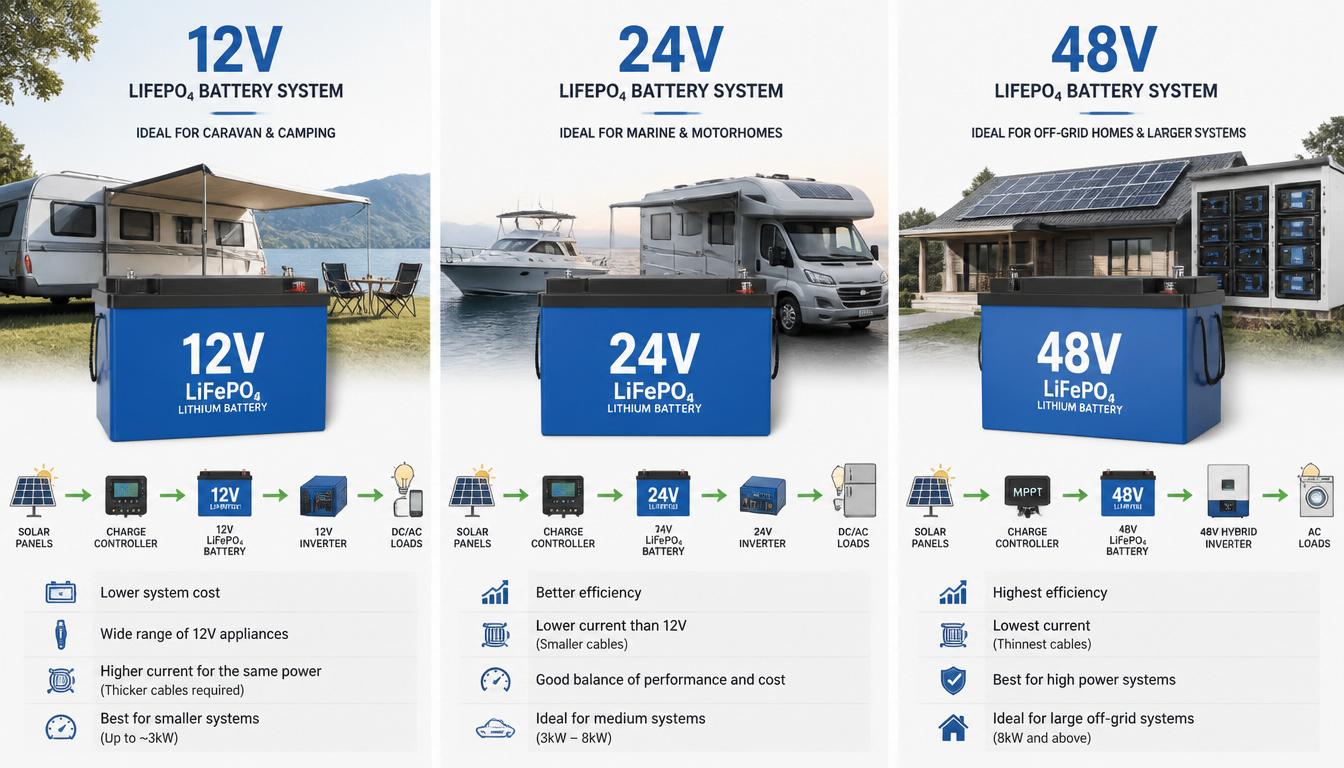
12V vs 24V vs 48V Lithium Batteries
Although all three battery voltages store energy, they differ in efficiency, current draw, wiring requirements, and ideal applications. The table below highlights the key differences between 12V, 24V, and 48V lithium batteries to help you choose the most suitable option for your power system.
12V Lithium Batteries
A 12V lithium battery is the most common choice for recreational and mobile power applications. It is widely used in caravans, camper trailers, 4WDs, boats, portable power systems, and small solar setups because most appliances and accessories in these environments are designed to operate on 12V power.
Its simplicity, compatibility, and ease of installation make it a popular option for both first-time users and experienced travellers.
Advantages
- Widely Compatible with 12V Appliances – Works seamlessly with most caravan, camping, marine, and 4WD electrical equipment designed for 12V systems.
- Easy Installation – Integrates easily into existing 12V setups, often requiring fewer modifications than higher-voltage systems.
- Lower Upfront Cost – Typically involves lower equipment and installation costs, making it an accessible option for many users.
- Ideal for Beginners – Simple system design and broad compatibility make 12V lithium batteries a popular choice for first-time battery and solar system owners.
Limitations
- Higher current draw for large loads
- Requires thicker cables as power demand increases
- Less efficient for large off-grid systems
For most caravan and camping users running fridges, lights, water pumps, and small inverters, a quality 12V LiFePO4 battery is often sufficient.

Related Articles:
- How Much Power Can a 12V Lithium Battery Deliver?
- Lithium Batteries in Series vs Parallel
- How Many Lithium Cells to Build a 12V or 24V Battery?
24V Lithium Batteries
A 24V lithium battery system offers a practical balance between simplicity and efficiency, making it a popular choice for users with higher energy demands. It is commonly used in medium-sized solar systems, larger caravans, motorhomes, marine applications, and workshops where greater power capacity is required.
By operating at a higher voltage than a 12V system, a 24V setup can reduce current flow and improve overall system efficiency while remaining relatively straightforward to install and maintain.
Advantages
- Lower Current Than 12V Systems – Reduces cable losses and voltage drop while supporting higher-power applications more effectively.
- Improved Inverter Efficiency – Many medium-to-large inverters can operate more efficiently in 24V systems because lower current reduces electrical losses.
- Reduced Cable Losses – Particularly beneficial for systems with longer cable runs or higher power requirements.
- Better Support for Higher-Power Loads – Well suited to running larger appliances and multiple devices simultaneously without placing excessive strain on the electrical system.
Limitations
- Requires 24V-compatible equipment
- Higher initial system cost
Many marine and off-grid users choose 24V systems when they need to run larger inverters, air conditioning, or multiple appliances simultaneously.

48V Lithium Batteries
A 48V lithium battery system is typically the preferred choice for high-power applications where efficiency, scalability, and performance are priorities. It is commonly used in large off-grid solar systems, residential energy storage setups, commercial solar installations, high-power marine systems, and backup power solutions.
Because a 48V system can deliver substantial power with lower current, it helps reduce energy losses, minimise cable sizes, and improve overall system efficiency.
Advantages
- Highest Efficiency – Delivers power with minimal energy loss, making it ideal for large solar and energy storage systems.
- Lowest Current Draw – Supports high-power applications with reduced electrical losses and improved system performance.
- Smaller Cable Requirements – Lower current often allows smaller cable sizes compared with equivalent 12V systems, although final cable sizing depends on installation requirements.
- Easier Scalability – Well suited to expanding battery banks and solar systems as energy demands increase over time.
- Better Performance with Large Inverters – Supports high-capacity inverters more efficiently, making it ideal for running substantial household, commercial, or off-grid loads.
Limitations
- Requires specialised 48V equipment
- Higher system complexity
- Generally unnecessary for small setups
For serious off-grid living or solar energy storage, 48V systems have become the preferred choice for many large off-grid and residential energy storage installations due to their efficiency and scalability.

Which Voltage Is Right for Your Application?
|
Feature |
12V | 24V | 48V |
|
Typical Use |
Camping, caravans, boats | Larger caravans, marine, medium solar | Off-grid homes, commercial solar |
|
Power Demand |
Low to moderate | Moderate to high |
High |
| Installation Complexity | Low | Medium |
High |
| Efficiency | Good | Better |
Best |
| Scalability | Limited | Good |
Excellent |
Expert Tip: Consider Future Expansion
Many people choose a battery system based only on their current requirements. However, future upgrades such as larger solar arrays, additional appliances, air conditioners, or inverter upgrades can significantly increase energy demand.
If expansion is likely, selecting a higher-voltage system from the beginning may reduce future upgrade costs and improve long-term efficiency.
Need Reliable Lithium Batteries for Marine, Caravan, and Off-Grid Systems?
For Australian caravan, marine, and off-grid users, Muller Energy offers a range of LiFePO4 energy solutions, including 12V, 24V, and 48V lithium batteries, solar panels, battery chargers, inverters, and DIY battery components such as battery management systems (BMS).
Muller Energy batteries are designed in Australia and supported by a team that provides personalised technical advice for users building or upgrading energy systems.
Frequently Asked Questions
Q1. Can I connect multiple 12V lithium batteries to create a 24V or 48V system?
Yes. Lithium batteries can often be connected in series to increase voltage. Always verify the manufacturer’s specifications and BMS compatibility before doing so.
Q2. Does Battery Voltage Need to Match the Inverter?
Yes. The battery voltage must match the inverter’s input voltage rating. For example, a 24V battery system requires a 24V inverter, while a 48V battery system requires a 48V inverter. Matching the correct voltage helps ensure safe operation, optimal performance, and compatibility with your electrical system.
Q3. Can I Use Any Solar Charge Controller with a 12V, 24V, or 48V Battery?
No. Solar charge controllers must support the voltage of the battery system they are charging. While many MPPT charge controllers can automatically detect and operate with 12V, 24V, and 48V battery banks, compatibility varies between models. Always check the manufacturer’s specifications before installation.
Q4. Are 24V batteries better for boats?
For larger marine systems with high electrical loads, 24V batteries can offer improved efficiency and lower current draw compared to 12V setups.
Q5. Do lithium batteries last longer than lead-acid batteries?
In most applications, LiFePO4 batteries provide significantly longer cycle life, faster charging, deeper usable capacity, and lower maintenance requirements than traditional lead-acid batteries.